Research
I am fascinated by the physical and chemical signatures left behind by glaciers on Earth and Mars.
Recently, I have been especially interested in how mountain slopes respond to deglaciation and how transitions between ice sheets and alpine glacier systems occur. Below is a sample of ongoing and past projects (mostly in planetary science). My newest projects include studying postglacial gullying in Iceland, landslides in Greenland, and ice sheet extent in the Allan Hills of Antarctica.
Here is my CV (last updated: May 2026).
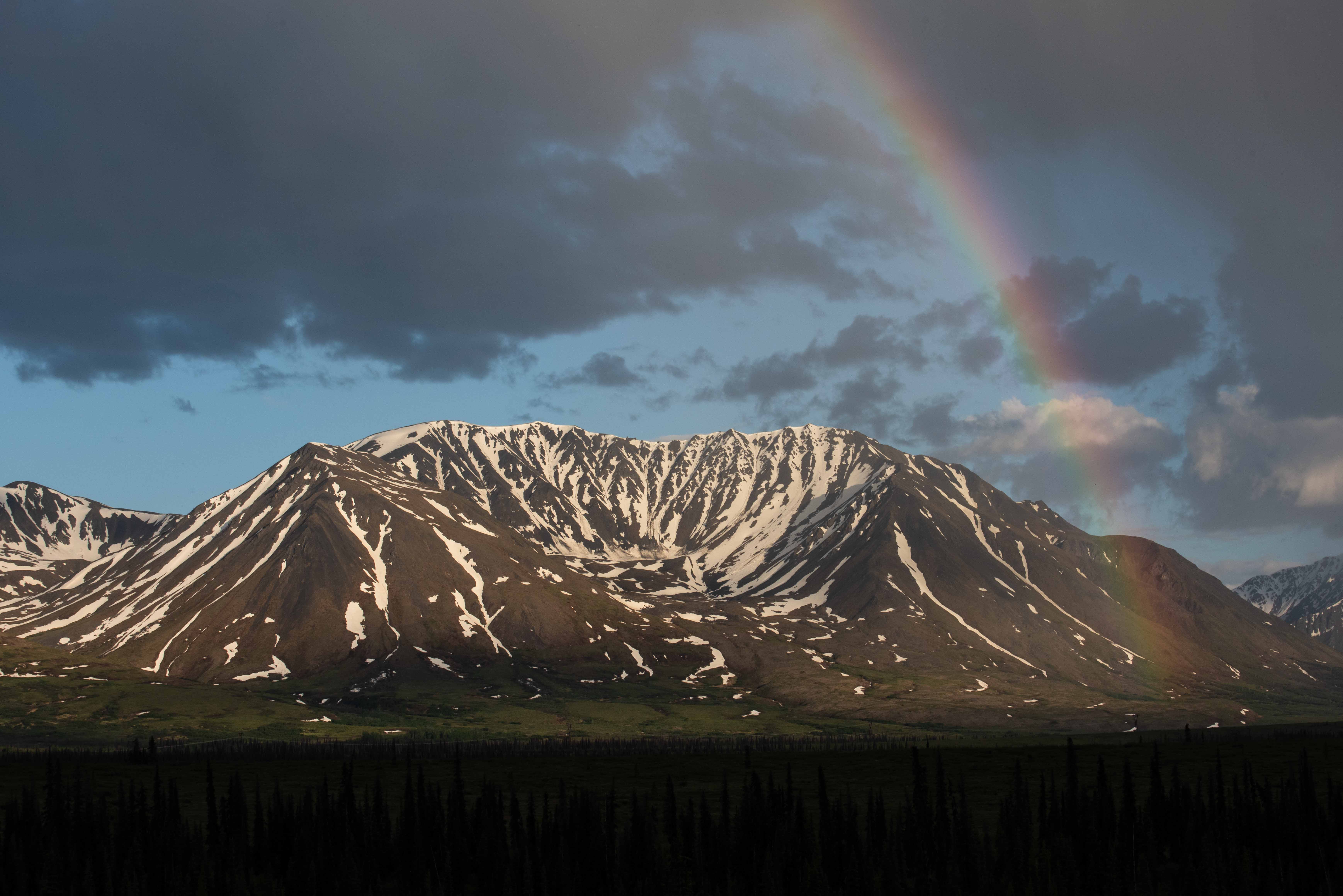
Behold my favorite landform that you may have never heard of! Cirques are bowl-shaped basins cut into mountainsides by glaciation, and some still hold glaciers while others don’t. I took this photo of a rainbow over a cirque in Alaska in June 2024.
Cirques in the northern mid-latitudes of Mars
On Earth, glacial cirques are understood to be eroded by wet-based glaciers, which have liquid water between the glacier and the bedrock. Most glaciers on Mars are understood to be cold-based, where the base of the glacier is frozen to the bedrock, with only recent evidence pointing to some landforms created by wet-based glaciation. We care about indicators of liquid water because they would suggest more habitable conditions for life in the past on Mars. I mapped 1991 alcoves on Mars in a region called Deuteronilus Mensae, and identified a population of 434 as the most “cirque-like” based on physical characteristics and measurements. This expands the amount and type of features known to be eroded by glaciers on Mars. See my paper here. Whether these cirque-like alcoves on Mars were eroded by wet-based glaciers like on Earth, or by cold-based glaciers but on 1-2 magnitude longer timescales, is still an open question!
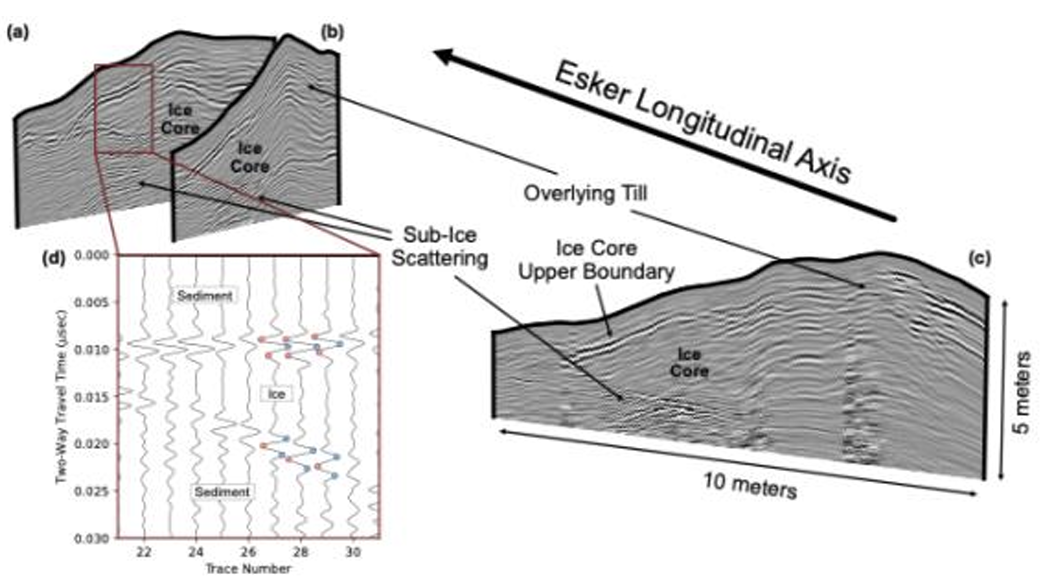
Ground-Penetrating Radar Investigations of Terrestrial Analogs for Mars: Eskers at Breiðamerkurjökull, Iceland
Eskers are ridges of sediment deposited by subglacial and englacial meltwater streams. Mars contains numerous ridges and landforms hypothesized to be ancient eskers, which suggests a warmer style of glaciation than previously hypothesized. Among a suite of other techniques, our team used ground-penetrating radar to study the internal structure of eskers emerging from Breiðamerkurjökull, an outlet glacier in Iceland as an analog for Mars. By evaluating the radar signatures for these eskers, we can apply this knowledge to radar instruments on Martian orbiters, rovers, and future missions. Our Mars Polar Science Meeting Abstract is available here.

Element mobility and aqueous alteration recorded by the PIXL instrument on the Mars Perseverance Rover
Using the PIXL instrument (a micro-X-ray fluorescence spectrometer) on the NASA Mars Perseverance rover, for the first time on Mars, we can map enrichments in different elements to minerals in rocks at the micro-scale. I use PIXL to measure how hydrothermal alteration has changed the elemental chemistry of the igneous rocks on Mars with comparisons to analogs on Earth. Check out my 10th International Conference on Mars abstract here.
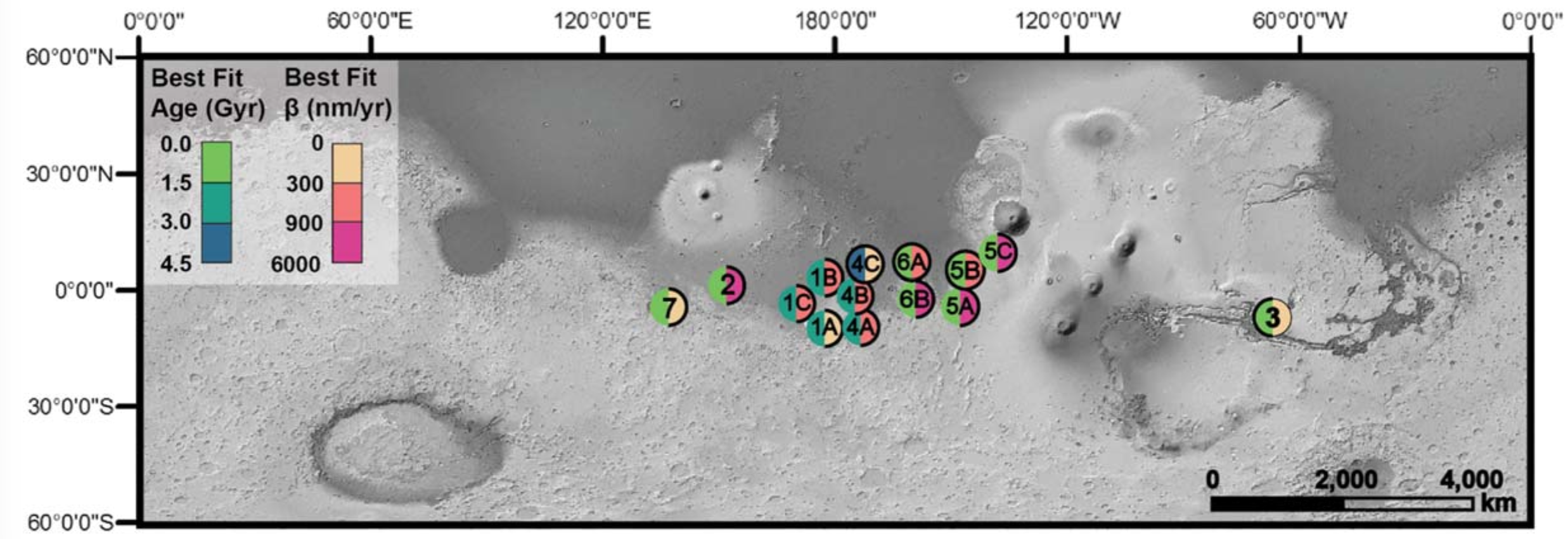
The Age and Erosion Rate of Young Sedimentary Rock on Mars
For my senior honors thesis with Edwin Kite at UChicago, I wrote a numerical model by treating cratering as a Poisson process to estimate the formation age and erosion rate of young sedimentary rock in the Medusae Fossae Formation (MFF) and other equatorial regions on Mars. Based on the locations with the highest erosion rates, we also provide estimates of the locations in the equatorial regions with shallow (within 1 m) subsurface ice. Read our paper here or Europlanet Science Congress (EPSC) abstract here. You can also read my entire thesis and see my code.

Additional undergraduate work
I'm grateful for the opportunity to explore a variety of research projects during my undergraduate career. This included my NASA Student Airborne Research Program (SARP) project "Salton Sea Chlorophyll: A Case Study of How Biology Responds to an Increasingly Hypersaline Environment" with Raphael Kudela at UCSC, a technical review paper about perchlorates on Mars with Pascal Lee at the SETI Institute, environmental quantum computing applications with Gavin Jones at IBM Research, and testing a new detector for the South Pole Telescope with Clarence Chang at Argonne National Laboratory. In undergrad I was excited (and still am!) about a lot of different Earth and space-related topics, so I enjoyed exploring a variety of topics.